Nickel Busbar for Battery Applications
Nickel busbar for battery applications, manufactured in Mumbai by Ramani Steel House. Where a strip interconnects cells, a busbar carries the combined current of a module — so the cross-section, not the weld pattern, is the governing dimension. Supplied in pure nickel at 99.8%, cut to the width and thickness your module drawing calls for.
Busbar or strip — which your pack needs
Nickel strip joins cells within a parallel group and carries the current of those cells only. A busbar joins groups or modules and carries their combined current, so it is sized on total current rather than per-cell current. Using strip where a busbar is needed is the more common error of the two, and it shows up as heating at the interconnect under load rather than as a failed weld.
What we supply
- Pure nickel busbar at 99.8% purity, Nickel 201 / UNS N02201
- Nickel-plated and copper busbar where conductivity or cost dictates
- Width and thickness cut to your module drawing
- Hole patterns and terminations to spec
- Minimum order 5 kg · despatch in 7 days
- Material test certificate on request
Applications
- EV battery modules and packs
- Grid and commercial energy storage (BESS)
- Industrial and traction battery assemblies
- Power tool and light-EV packs
Products
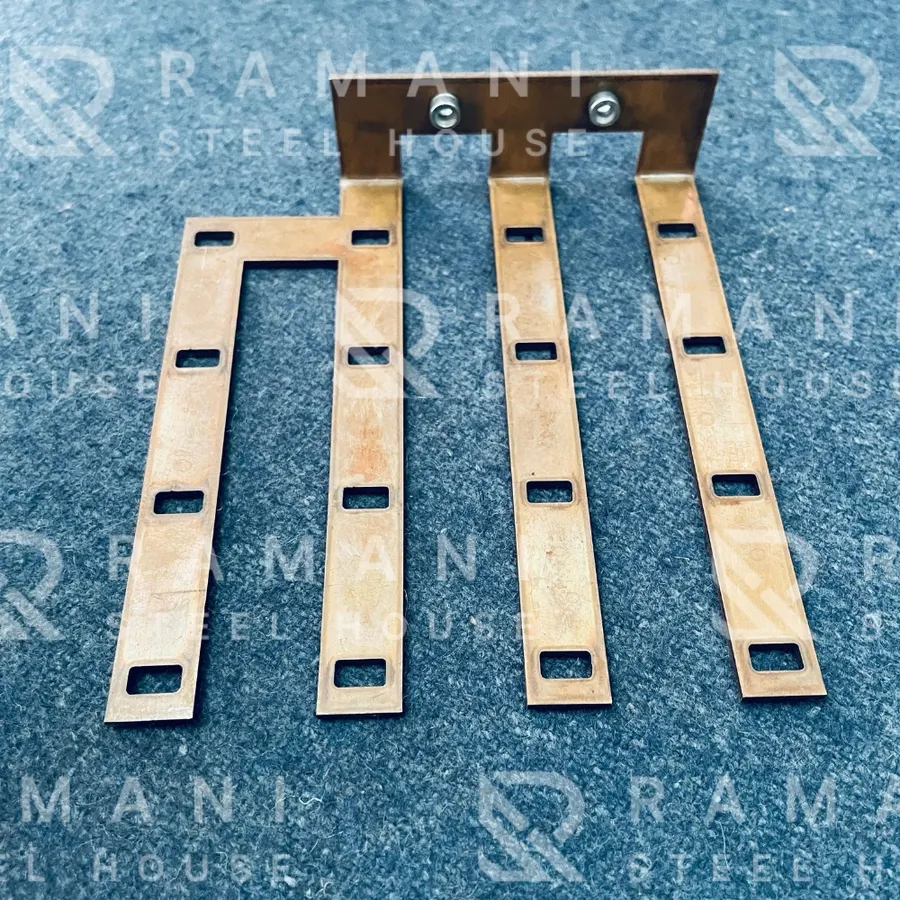 Copper Busbar
Frequently asked questions
What is a nickel busbar used for in a battery pack?
It carries current between parallel groups or between modules, where the combined current is higher than a cell interconnect strip is sized for. It is specified on cross-section against the total current it must carry.
Nickel busbar or copper busbar — which is better?
Copper has higher conductivity for the same cross-section; nickel resists corrosion better and welds directly to cell terminals without plating. Many packs use both, with nickel at the cell interface and copper for the longer current paths.
Can nickel busbar be made to our module drawing?
Yes. Width, thickness, length, hole pattern and terminations are cut to the drawing supplied. Send the drawing and the quotation is made against it rather than against a nearest standard section.
Also supplying
- Tamil Nadu
- Karnataka
- Maharashtra
- Gujarat
- Haryana
- Uttar Pradesh
- Telangana
- Andhra Pradesh
- Rajasthan
- West Bengal
Contact
Ramani Steel House, 65/73, C.P. Tank Road, Mumbai, Maharashtra 400004, India
Email: [email protected] / [email protected]
Phone: +91 83697 24730 / +91 80976 53930 / +91 81691 82418