Nickel Strip Current Capacity in Five Diagrams
Ramani Steel House ·
A nickel strip's safe current comes down to four steps: its size sets its resistance, resistance and current set the heat (P = I squared x R), and how fast that heat escapes sets the temperature. These five diagrams show each step, with the numbers from one worked example.
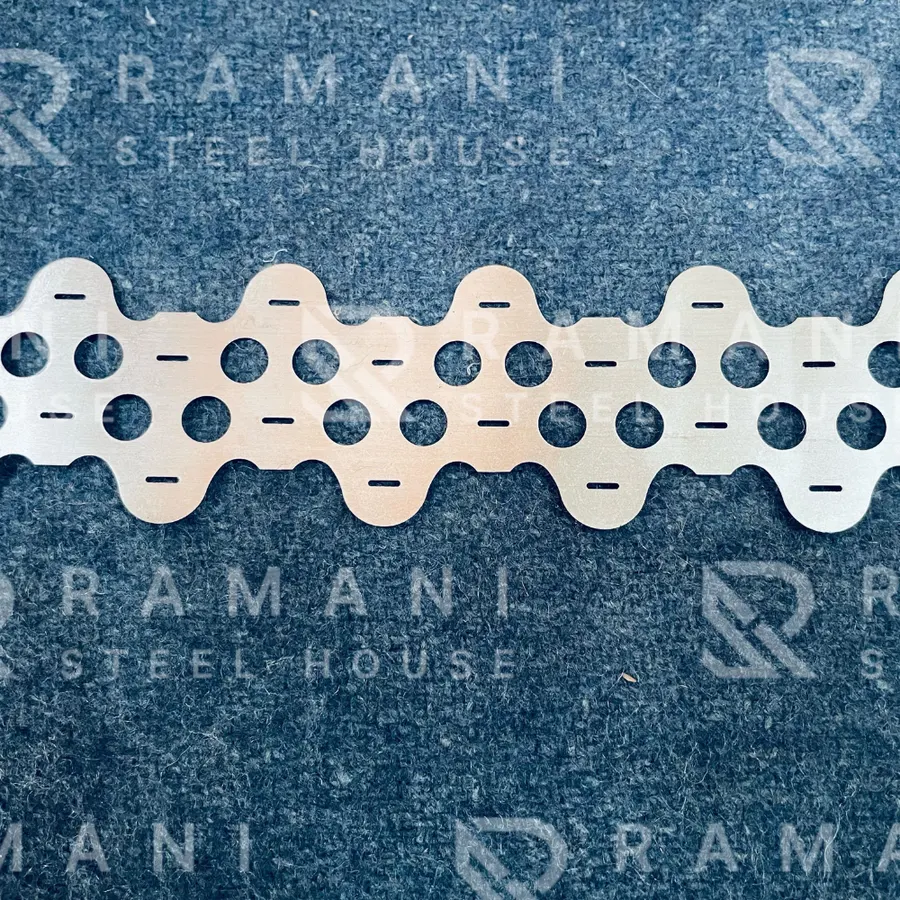
How much current a nickel strip can carry is easiest to see in pictures. These five diagrams walk through the engineering behind it, from strip size to temperature, using one real strip as the worked example. The full write-up, with every formula, is in our current-carrying capacity guide.
1. From strip size to temperature
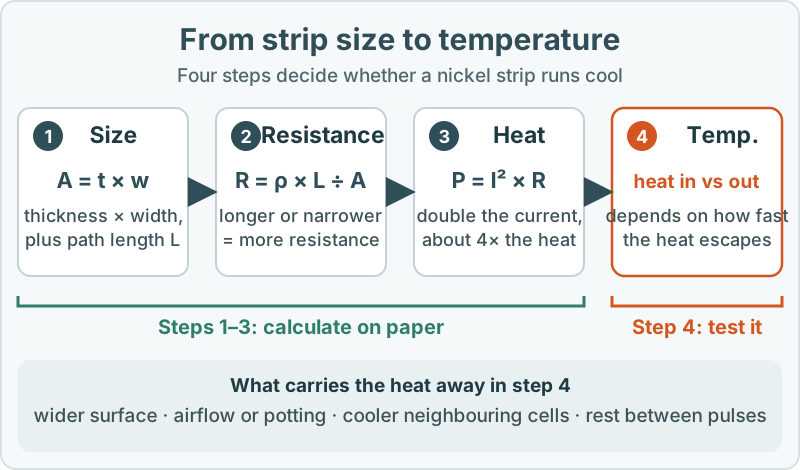
Every question about a strip's current capacity sits at one of four steps. The strip's size (thickness times width, plus the path length between welds) sets its resistance. Resistance and current together set the heat. And the temperature depends on how fast that heat escapes. The first three steps can be calculated; the fourth needs a test on a real assembly.
2. A worked example
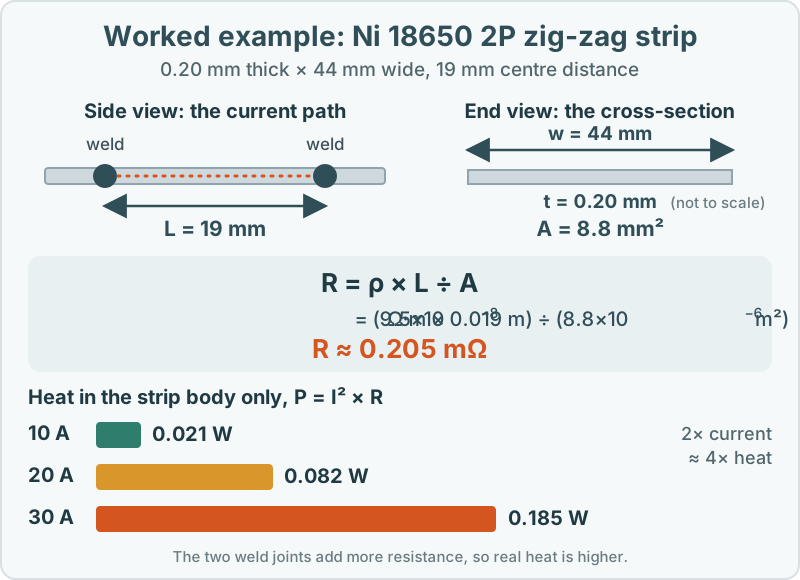
The Ni 18650 2P zig-zag strip is 0.20 mm thick and 44 mm wide, with 19 mm between cell contacts. That gives a cross-section of 8.8 mm² and a resistance of about 0.205 milliohms. At 10, 20 and 30 A the strip body dissipates 0.021, 0.082 and 0.185 W, so doubling the current roughly quadruples the heat. These figures cover the strip only; every weld adds resistance of its own.
3. Why width cools better than thickness
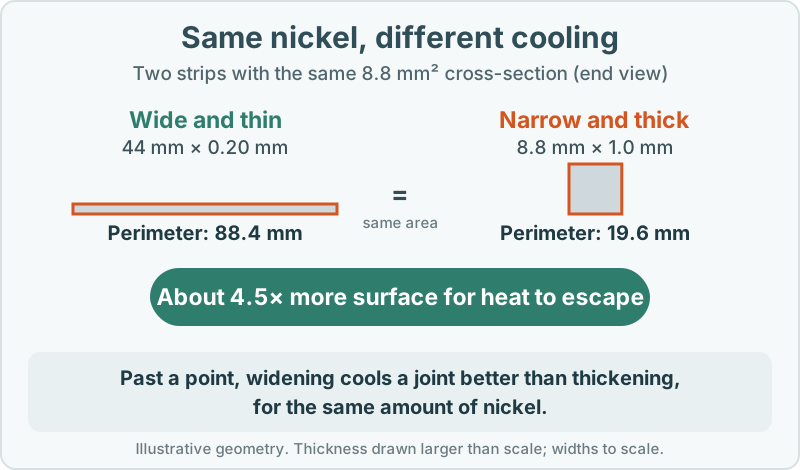
Two strips can hold the same cross-section of nickel and still cool very differently. A 44 mm × 0.20 mm strip and an 8.8 mm × 1.0 mm strip both measure 8.8 mm², but the wide one has a perimeter of 88.4 mm against 19.6 mm: about 4.5 times more surface for heat to escape. Past a point, widening a strip cools a joint better than thickening it, and thick strip is also harder to weld cleanly.
4. Why the same current can be safe or not
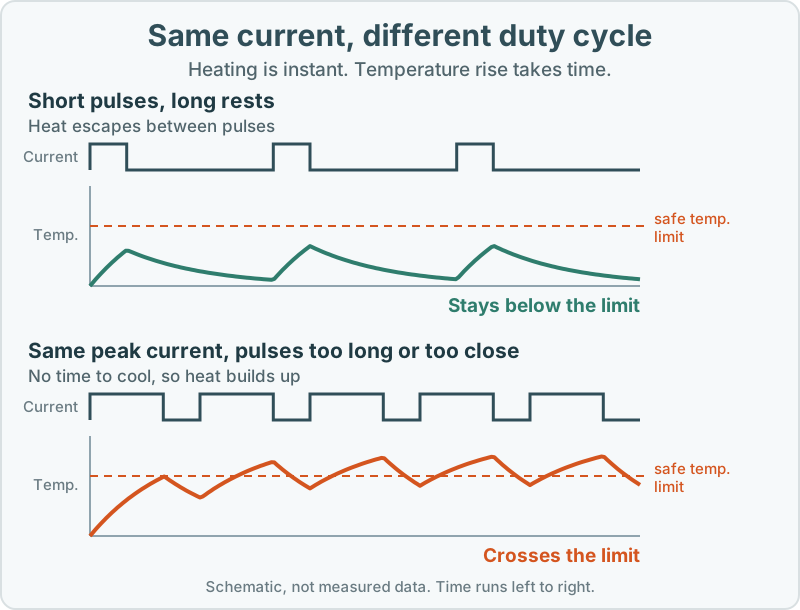
Heating is instant, but temperature rise takes time. Short pulses with long rests let the heat escape between them. The same peak current in longer or closer pulses lets heat build up until it crosses the safe limit. That is why a strip has to be sized for the duty cycle and not only the peak.
5. How a fuse-type neck works
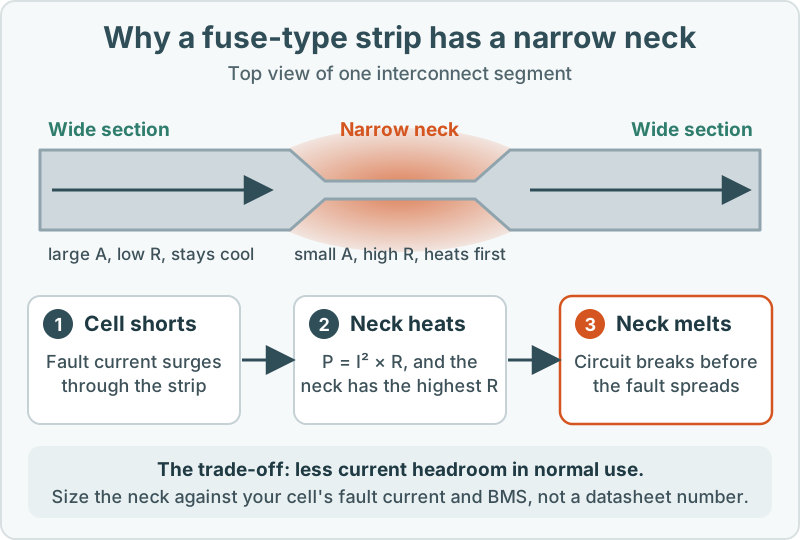
A fuse-type strip has a deliberately narrowed neck. Narrower means less cross-section, so higher resistance and more heat for the same current. In a cell short, the neck heats first and melts open before the fault can spread. The price is less current headroom in normal use, so the neck is sized against the cell's fault current and the BMS. Our guide to fuse-type vs plain strip covers when to use one.
Where to go next
- How to size nickel strip for a battery pack: the method, worked through for a 13S4P pack
- Why nickel strip overheats: five causes and how to check each
- Nickel strip current-carrying capacity: the full engineering guide
- What is nickel strip?
Products covered in this guide
Order nickel strip in your exact size
Standard thicknesses from 0.10 to 0.30 mm and widths from 2 to 50 mm, or any size made to your drawing. Orders start at 5 kg.
Frequently Asked Questions
How much current can a nickel strip carry?
There is no single figure. It depends on the strip's narrowest cross-section, the path length between welds, the welds themselves, how well heat escapes and the duty cycle. Calculate resistance and heat for your geometry, then confirm with a thermal test on a real assembly.
Why does doubling the current quadruple the heat?
Heat in a conductor is P = I squared x R. Current is squared, so doubling it gives four times the heat for the same resistance.
Why does a fuse-type strip have a narrow neck?
The narrowed section has higher resistance, so under fault current it heats and melts before the rest of the strip, opening the circuit before the fault spreads. It trades some current headroom for that protection.
Are these diagrams to scale?
Not all of them. Thickness is drawn larger than real in the cross-section diagrams, and the duty-cycle chart is a schematic rather than measured data. The numbers in the worked example are calculated from the strip's real dimensions.
More nickel strip guides
Related articles
Related categories
All nickel strip guides · Technical articles · Nickel strip and busbar products