Why Did My Nickel Strip Overheat or Melt? 5 Causes and How to Check Each
Ramani Steel House ·
A nickel strip that runs hot is usually too small for the current, welded poorly, sized for a steady current when the real load peaks, short of cooling, or the wrong material or pattern. The quickest diagnosis is where it is hottest: at the welds points to the joints, along the whole strip to sizing or cooling, and at a narrow neck to the fuse pattern.
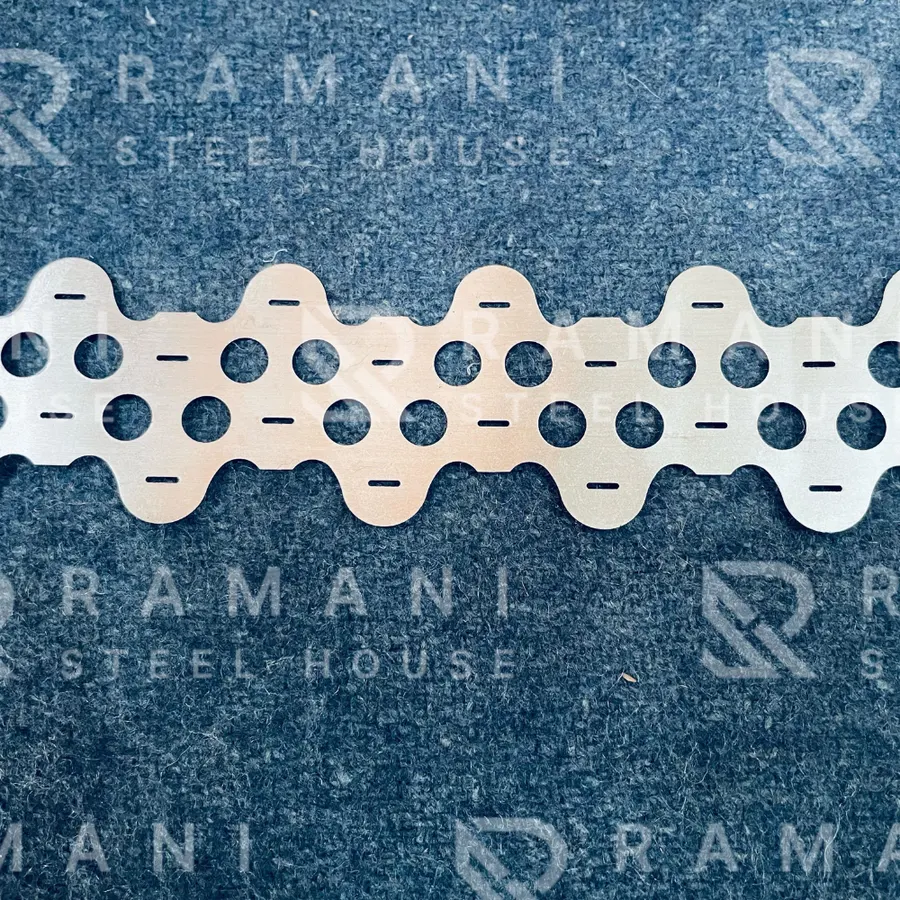
When a nickel strip runs hot in a battery pack, the nickel is rarely the problem. The usual causes are a strip that is too small for the current, welds that carry more resistance than the strip itself, current peaks that were never in the sizing, or heat with nowhere to go. This guide takes the five causes in turn and shows how to tell them apart with a thermometer, a multimeter and one formula.
The quick answer: look at where the strip is hottest. A hot spot at the welds, a strip that is hot along its whole length, and a hot narrow neck each point to a different cause.
Does nickel strip actually melt?
Almost never. Nickel melts above 1,400 °C, far above the temperatures at which cells and their insulation fail. What gives up first is everything around the strip: separators, insulation, heat-shrink, cell seals and the weld joint itself. So “my strip overheated” is the real problem to solve, long before “my strip melted”.
The exception is deliberate. A fuse-type strip has a narrowed neck designed to melt open under fault current. If a neck has opened, the strip did its job, and the question becomes why the current was that high.
Read the hot spot first
Put a thermocouple or thermal camera on the pack while it runs at its real load, and note which part of the interconnect is hottest.
| Where it runs hottest | Most likely cause | First thing to check |
|---|---|---|
| At the weld spots, with the strip between them cooler | Weak or inconsistent welds (cause 2) | Pull-test welds and measure the voltage drop across one joint under load |
| Evenly along the whole strip | Strip too small for the current (cause 1), or heat cannot escape (cause 4) | Recalculate with the narrowest cross-section; check potting, airflow and cell spacing |
| Only during acceleration or fast charge | Peak current missing from the sizing (cause 3) | Log the real current profile and compare it with the figure you sized for |
| At the narrow neck of a fuse-type or zig-zag strip | Neck too tight for the current, or normal fuse action (cause 5) | Compare the neck width with the current and with your BMS trip point |
| Everywhere, and resistance is higher than the calculation | Wrong material or grade (cause 5) | Check the material test certificate for grade, UNS number and purity |
Cause 1: The strip is too small for the current
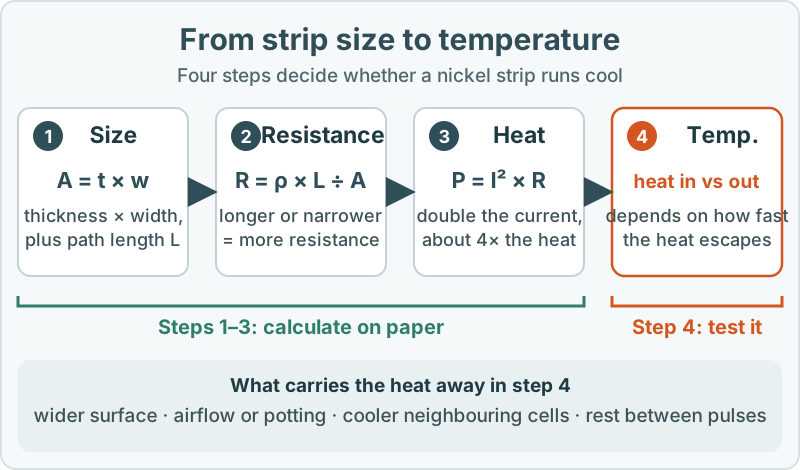
Resistance depends on the strip's size: R = ρ × L ÷ A, where A is thickness times width, L is the current path between welds, and ρ is nickel's resistivity (about 9.5 x 10^-8 ohm-metres). Heat is P = I² × R. So halving the cross-section doubles the resistance and doubles the heat at the same current, while doubling the current quadruples the heat.
The strip in our current-carrying capacity guide (0.20 mm × 44 mm, with 19 mm between cell contacts) has a resistance of about 0.205 milliohms. At 30 A that is 0.185 W in the strip body. That is small, and for a well-sized strip it should be. The danger is the cross-section you forgot: holes, cut-outs and fuse necks all reduce it, and resistance is set by the narrowest point on the current path, not the full width of the strip.
How to check: measure the narrowest cross-section on the actual part, recalculate R and P, and compare them with the temperature you measured. Our calculator handles the unit conversions.
Cause 2: The welds are weaker than the strip
Every spot weld is a joint with its own contact resistance, and that resistance is not in the strip formula. A poor weld can dissipate more heat than the whole stretch of strip beside it. That is why the signature of this cause is a hot spot at the weld while the strip between the welds stays cooler, sometimes with discolouration around the spot.
The usual reasons are surface oxidation from storage, too little weld energy or electrode force, a contaminated surface, or strip too thick for the welder settings (thicker strip needs more weld energy, which raises the risk of an inconsistent nugget).
How to check: pull-test welds from the same batch, and measure the voltage drop across a single weld under load. Divide it by the current and you have that joint's resistance. If it is comparable to the strip's own resistance, or larger, the weld is your problem rather than the strip. See our guides on spot welding tips, storage and oxidation and common defects.
Cause 3: The sizing ignored the peak
Heat rises with the square of current, so a peak is worse than it looks: 40 A produces (40 ÷ 30)² = 1.78 times the heat of 30 A. Acceleration and fast charging produce exactly these peaks. Heating is instant, but temperature rise takes time, so what decides the outcome is the duty cycle: a short pulse followed by a long rest lets the heat escape, while the same peak held longer or repeated sooner does not.
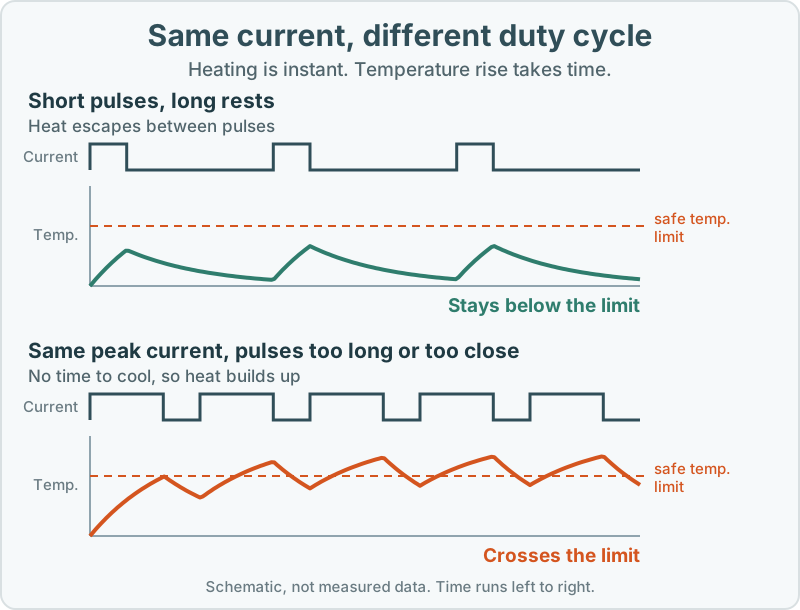
How to check: log the real current profile instead of using the nameplate figure, and size for the peak and the duty cycle together.
Cause 4: The heat has nowhere to go
Two identical strips can run at different temperatures purely because of their surroundings: potting compound, airflow, the temperature of the cells they touch, and how tightly the enclosure is packed. Shape matters too. A wide, thin strip exposes far more surface than a narrow, thick strip with the same cross-section, so for the same nickel, widening cools a joint better than thickening.
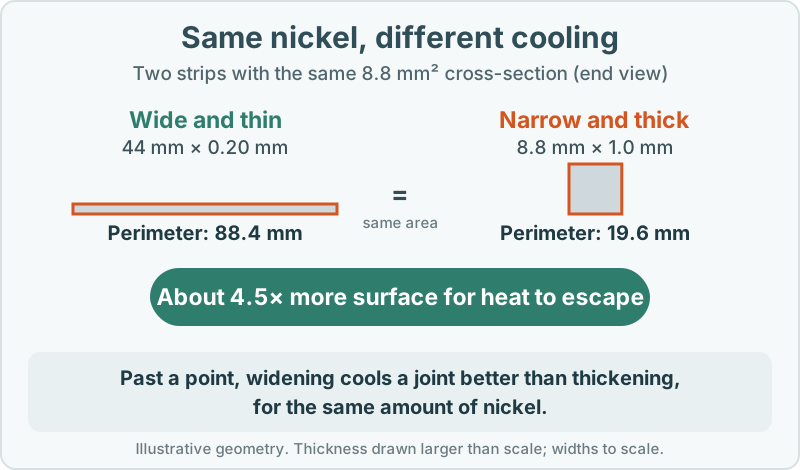
How to check: compare the interconnect's temperature with the cells it touches. If the whole pack is warm and the strip is only slightly hotter, the fix is thermal design, not a bigger strip.
Cause 5: The wrong material, or the wrong pattern for the job
Two mistakes sit here.
- Nickel-plated steel in place of pure nickel. Nickel-plated steel has higher resistance than pure nickel, so a strip that looks identical runs hotter at the same size. Ask for the grade and UNS number (Nickel 200 is N02200, Nickel 201 is N02201) and a material test certificate for the batch. See pure nickel vs nickel-plated steel strip.
- A fuse-type pattern where current capacity matters. The narrowed neck of a fuse-type strip gives up current headroom on purpose. In a pack that needs to carry as much current as possible, a plain or H-type strip is the better choice.
How to find the cause for certain
- Measure temperature at four points under real load: at a weld, mid-strip, at any neck, and on a neighbouring cell.
- Calculate the strip's resistance from its narrowest cross-section, then measure the voltage drop along a clean stretch of strip at a known current. If measured and calculated resistance agree, the strip is behaving as designed.
- Measure the drop across a weld the same way. A weld that drops more voltage than the strip beside it is the heat source.
- Change one thing at a time (weld energy, strip width, potting) and measure again.
Stop testing at full load if anything is hotter than the cell datasheet allows. A hot interconnect can also mean a faulty cell, and a pack that is still heating is not one to leave running.
When the fix is a different strip
If the numbers say the strip is too small, the options run from lowest to highest risk: widen it (it cools better and is not harder to weld the way thickening is), run strips in parallel at a thickness you can weld reliably, or move to a busbar-style link once the current outgrows strip. Our guides on nickel strip vs nickel busbar and nickel strip vs copper busbar cover that handover.
Ramani Steel House makes H-type, zig-zag, fuse-type and plain nickel strip in Mumbai (Nickel 201 for the patterned strip, Nickel 200 for plain), with material test certificates on request and a 5 kg minimum order. Browse the catalogue, or send your current, cell format and layout and we will quote against them.
Products covered in this guide
Order nickel strip in your exact size
Standard thicknesses from 0.10 to 0.30 mm and widths from 2 to 50 mm, or any size made to your drawing. Orders start at 5 kg.
Frequently Asked Questions
Can a nickel strip actually melt in a battery pack?
Only a deliberately narrowed fuse neck should. Nickel melts above 1,400 C, far above the temperatures at which cells and insulation fail, so overheating damages the rest of the pack long before the strip body melts.
How hot is too hot for a nickel strip?
There is no single figure for the strip. The limit is set by the weakest material next to it: the cell's rated temperature, the separators, the insulation and your own design limit. Use the cell datasheet and a validation test under real load.
Why is the weld hotter than the strip?
A weld has its own contact resistance, which is not in the strip formula. If a weld drops more voltage than the strip beside it at the same current, it dissipates more heat. Weld energy, electrode force and surface condition are the usual causes.
Does a thicker nickel strip always run cooler?
Not always. Thickness lowers resistance, but it adds less cooling surface than width does, and thicker strip is harder to weld consistently. Past a point, widening cools a joint better than thickening.
Is a strip with an opened fuse neck faulty?
No, it did its job. The neck is designed to open under fault current, so an opened neck points to a cell short or an overload. Find that cause before fitting a replacement strip.
More nickel strip guides
Related articles
Related categories
All nickel strip guides · Technical articles · Nickel strip and busbar products