What Is Nickel Strip? A Plain-English Guide for Battery Builders and Buyers
Ramani Steel House ·
Nickel strip is thin, flat commercially pure nickel, usually Nickel 200 or Nickel 201 to ASTM B162, supplied as coil or stamped patterns and spot welded between lithium-ion cells to connect them in parallel and in series. It is sold by weight to a specified grade, thickness, width and pattern.
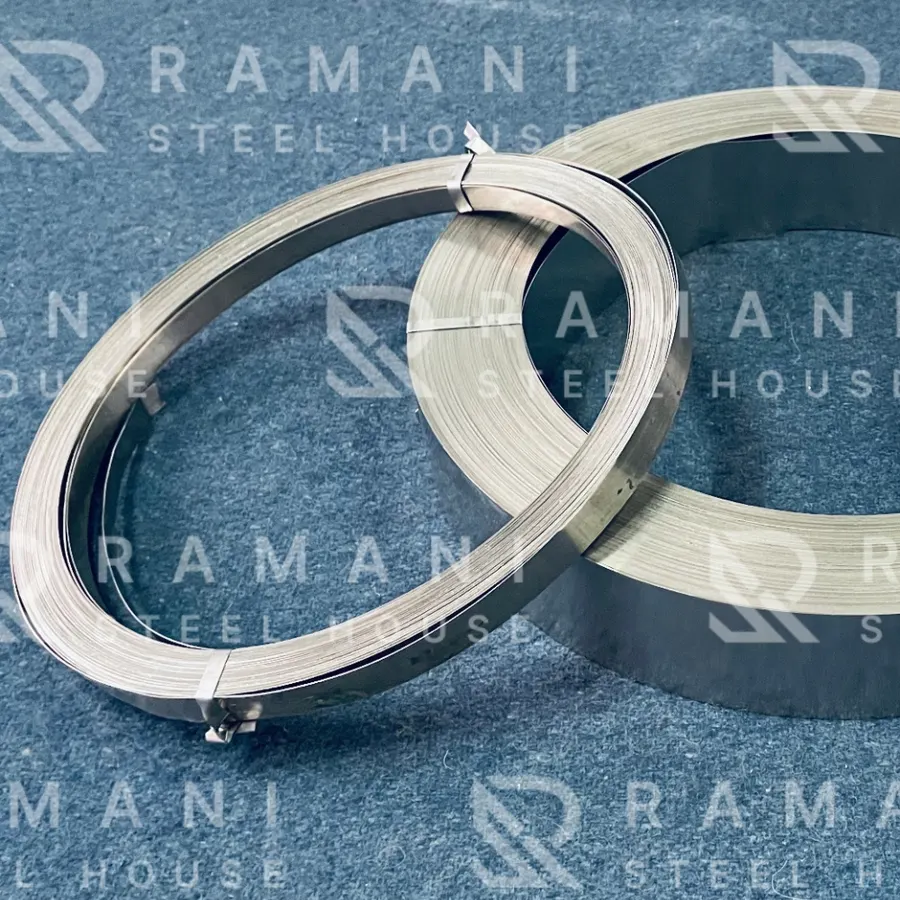
Nickel strip is thin, flat nickel, usually Nickel 200 or Nickel 201, supplied as coil or cut patterns and used to connect cells inside lithium-ion battery packs by spot welding. It is the interconnect between cells in packs for EVs, power tools and energy storage, and it is bought by weight to a specified grade, thickness, width and pattern.
Nickel strip at a glance
| Property | Typical specification |
|---|---|
| Material | Commercially pure nickel: Nickel 200 or Nickel 201 |
| Standard | ASTM B162 |
| UNS numbers | N02200 (Nickel 200) and N02201 (Nickel 201) |
| Nickel content | 99.0% minimum (plus cobalt) by the grade specification; Ramani Steel House supplies 99.8% pure nickel |
| Thickness | 0.10 mm to 0.50 mm as standard; the stamped patterns in the catalogue are 0.15 mm and 0.20 mm |
| Forms | Plain strip, slit coil, and stamped H-type, zig-zag, honeycomb and fuse-type patterns |
| Joined by | Resistance spot welding |
| Sold by | The kilogram (minimum order 5 kg from Ramani Steel House) |
What is nickel strip made of?
Nickel 200 (UNS N02200) and Nickel 201 (UNS N02201) are commercially pure wrought nickel. Nickel 201 is the low-carbon variant and is preferred for repeated spot welding, so our stamped H-type, zig-zag and fuse-type strip is supplied in Nickel 201, while plain strip is supplied in Nickel 200. Nickel 200 vs Nickel 201 explains the difference in detail.
Nickel strip is solid nickel all the way through. That separates it from nickel-plated steel strip, which is a steel core with a thin nickel layer. The plated product costs less but has higher resistance; our pure nickel vs nickel-plated steel comparison covers when each is appropriate.
What is nickel strip used for?
Almost all of it goes into lithium-ion battery packs, where it connects cells to each other. Cells wired in parallel form a group (the P in 2P, 3P or 4P), groups wired in series add voltage (the S), and nickel strip is welded across the cell terminals to make both connections. The main uses are:
- EV battery packs and modules
- Power tool and other portable battery packs
- Energy storage systems
- Cell formats from 18650 and 21700 to 32650 and 32700
How the strip is patterned depends on the layout: see 2P vs 3P vs 4P interconnect design and 18650 vs 21700 nickel strip.
Why nickel, and not copper or steel?
- It spot-welds cleanly. Nickel's higher resistivity and low thermal conductivity (roughly 70 W/m·K for Nickel 200) keep heat at the weld. Copper's very low resistivity and high thermal conductivity (roughly 390–400 W/m·K) carry heat away, which is why copper is bolted or laser-welded rather than resistance spot welded.
- It resists corrosion. Nickel forms a stable oxide film, so strip is normally left unplated.
- It is not the best conductor, and does not need to be. Nickel 200 is roughly five and a half times more resistive than annealed copper, so copper busbar carries the bulk current between modules while nickel strip makes the weldable cell-level connections. See nickel strip vs copper busbar.
The main types of nickel strip
| Type | What it is | Typical use |
|---|---|---|
| Plain strip | Unpatterned strip slit to width from coil | General tabs and interconnects, and custom sizes |
| H-type | Stamped strip with H-shaped cut-outs between cell contacts, made for 2P, 3P and 4P groups | The standard multi-cell interconnect |
| Zig-zag and honeycomb | A zig-zag pattern that flexes to absorb cell movement | Irregular cell spacing and flexible layouts; see zig-zag vs H-type |
| Fuse-type | A narrowed neck that acts as a fusible link and opens under fault current | Packs that want a fault contained at the cell tab; see fuse-type vs plain strip |
| Custom | Cut to your pitch, width and hole pattern | Layouts no standard pattern fits |
How nickel strip is specified
When you ask for a quotation, these are the details that define the part, and the ones that must match if you are comparing suppliers:
- Grade and UNS number: Nickel 200 (N02200) or Nickel 201 (N02201), supplied to ASTM B162
- Thickness: see the thickness guide and the current-carrying capacity guide for how to choose
- Width
- Pattern: plain, H-type, zig-zag, honeycomb, fuse-type or custom
- Cell format and spacing: 18650, 21700, 32650 or 32700, and the distance between cell centres (the “CD” on a drawing)
- Quantity in kilograms
- Documentation: whether you need a material test certificate (and how to read one)
How nickel strip is sold
Nickel strip is sold by weight but used by length. Nickel has a density of about 8.9 g/cm³, so the weight per metre of solid strip is thickness (mm) × width (mm) × 8.9 grams. A 0.15 mm × 27 mm strip weighs 36 g per metre, which makes 5 kg roughly 139 metres. A stamped pattern removes metal, so patterned strip gives more length per kilogram than the same size solid. Our minimum order guide works through this, the calculator does the conversion for you, and our guides to nickel strip price per kg in India and pricing for bulk orders explain what drives the price per kilogram.
Where to go next
- How much current can nickel strip carry?
- How to size nickel strip for a battery pack
- Spot welding tips for nickel strip
- Why nickel strip overheats
- How to test a sample before a bulk order
- Nickel strip for e-rickshaw and e-bike battery packs
- How to choose a nickel strip manufacturer in India
Ramani Steel House has manufactured nickel strip and busbar in Mumbai since 1974. Browse the catalogue or send your specification for a quotation.
Products covered in this guide
Order nickel strip in your exact size
Standard thicknesses from 0.10 to 0.30 mm and widths from 2 to 50 mm, or any size made to your drawing. Orders start at 5 kg.
Frequently Asked Questions
What is nickel strip made of?
Commercially pure nickel, usually Nickel 200 (UNS N02200) or Nickel 201 (UNS N02201), supplied to ASTM B162. Both grades specify at least 99.0% nickel, and Ramani Steel House supplies 99.8% pure nickel.
What is nickel strip used for?
Connecting cells inside lithium-ion battery packs. It is spot welded across cell terminals to wire cells in parallel and in series, in EV battery packs, power tools, energy storage systems and other portable packs.
Is nickel strip the same as nickel-plated steel strip?
No. Nickel strip is solid nickel throughout, while nickel-plated steel is a steel core with a thin nickel layer. The plated product costs less but has higher resistance, so the two are not interchangeable where conductivity matters.
What thickness is nickel strip for 18650 batteries?
It depends on the current the interconnect carries, not on the cell format alone. Standard thicknesses run from 0.10 mm to 0.50 mm, and the patterned 18650 strips in our catalogue are 0.15 mm and 0.20 mm. Our thickness and current-carrying capacity guides explain how to choose.
How is nickel strip joined to a battery cell?
By resistance spot welding. Nickel's resistivity and relatively low thermal conductivity let heat build at the weld interface, which is why it welds cleanly where copper does not.
How is nickel strip sold?
By weight, usually in kilograms, to a specified grade, thickness, width and pattern. Ramani Steel House supplies from a 5 kg minimum order. The weight per metre of solid strip is thickness in mm times width in mm times 8.9 grams.
More nickel strip guides
Related articles
Related categories
All nickel strip guides · Technical articles · Nickel strip and busbar products